Search monitor alternatives
“Search monitor” means three different jobs. Pick by yours.
Search Google for “search monitor alternatives” and almost every result is about The Search Monitor, an ad-compliance and brand-protection platform. If that is the job you need, we will point you to the right tools and step aside honestly. But the same phrase hides a second, more basic job: watching whether your own pages are in Google at all and stay there. That is a different category, and it is the one SearchOptimo is built for.
Key takeaways
- The SERP for "search monitor alternatives" is dominated by The Search Monitor, a paid-search and brand-compliance tool, not an SEO or index tool.
- For its actual job (ad, affiliate, and trademark monitoring), the real alternatives are Adthena, Tracer, SnapDragon, Marcode, and ImpersonAlly.
- A separate crowd means "search monitor" as "watch my search presence": either rank position or, more basically, index status.
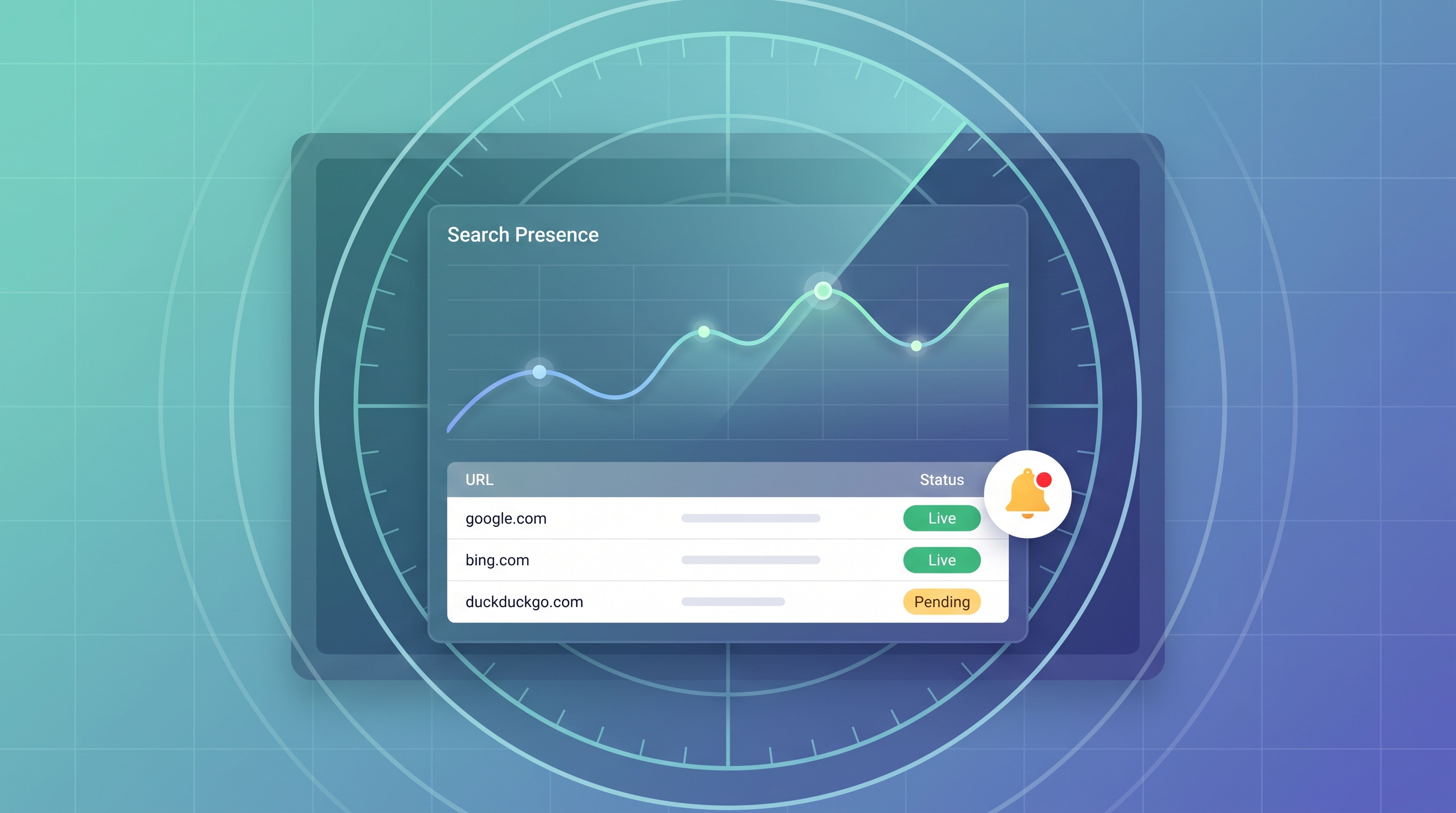
- SearchOptimo owns the upstream job the others assume is solved: it checks whether each URL is indexed on a schedule and alerts you the day one drops out. Free tier, no card.
What is the best search monitor alternative?
There is no single best alternative, because “search monitor” describes three unrelated jobs. For ad and brand-compliance monitoring (the job The Search Monitor does), the alternatives are ad-intelligence tools like Adthena, Tracer, and SnapDragon. For website change monitoring, tools like Hexowatch and Visualping. For monitoring whether your own pages stay indexed by Google, a focused index monitor like SearchOptimo.
So the honest first step is not comparing tools, it is naming the job. Match the job to the category below, and the shortlist picks itself.
If you meant The Search Monitor, here is the honest answer
The Search Monitor is a paid-search and brand-compliance platform. It watches ads, affiliates, and trademark use across search engines so brands can catch competitors bidding on their name, spot ad hijacking, and keep affiliates in line. That is a real, valuable job, and it is not one SearchOptimo does.
If that is what you came for, the alternatives that actually replace it are ad-intelligence and brand-protection tools: Adthena and Tracer for paid-search intelligence, SnapDragon for brand protection, and newer entrants like Marcode and ImpersonAlly for affiliate and impersonation monitoring. We are not going to pretend an index monitor competes with those. Confirm current features and pricing on each provider’s own site.
Search monitor alternatives by job
Four different jobs hide behind the same phrase. Find your row first, then the tools on the right are the ones worth your time.
| The job you mean | What it actually is | Best-fit tools | Reality |
|---|---|---|---|
| Ad, affiliate & brand-compliance monitoring | The Search Monitor’s own lane: policing paid ads, trademark bidding, and affiliates. | Adthena, Tracer, SnapDragon, Marcode, ImpersonAlly | Enterprise, quote-based. This is not SearchOptimo’s lane. |
| Website change monitoring | Watching a page’s content, price, or HTML for any visual or code change. | Hexowatch, Visualping, UptimeRobot | General change detection, not search-specific. |
| Rank / keyword-position monitoring | Tracking where an already-ranking page sits for its keywords. | Advanced Web Ranking, Ahrefs, Semrush | Assumes the page is already indexed. |
| Search-index presence monitoring | Is my page actually in Google, and does it stay there over time? | SearchOptimo | The upstream job the others assume is already solved. Free tier to start. |
Tool capabilities and pricing change over time. Confirm current details on each provider’s own site before you decide.
The job most people forget: index monitoring
Rank trackers and SEO suites all quietly assume your page is already in Google’s index. That assumption breaks more often than people expect. A page can be dropped for a “Crawled – currently not indexed” status, a bad deploy, a stray noindex tag, or a Google update, and a rank tracker shows nothing dramatic because there is no ranking left to lose.
A rank monitor tells you
- Where an already-indexed page ranks for its keywords
- Position changes over time
- Competitor movement in the same results
An index monitor tells you
- Whether each URL is in Google’s index at all, right now
- The day a page drops out, per URL
- The full index-status history for each page over time
If your real worry is search presence rather than ad compliance, index monitoring is the layer you are missing. It is also the layer Google Search Console reports slowly, and the reason the Page Indexing report frustrates so many people.
Where SearchOptimo fits: the index-monitoring lane
SearchOptimo is not trying to be Adthena, Hexowatch, or a rank tracker. It does one job those tools assume is already handled: it watches whether your URLs are and stay indexed by Google, and tells you the moment they are not.
Scheduled re-checks
Re-check index status daily or every 6 hours, so a drop is caught in hours, not on a report delay.
Per-URL drop alerts
Get emailed the specific page that left the index, instead of decoding an aggregate count.
7–365 day history
Keep a per-URL index-status timeline you hold independently, not a rolling 16-month window.
IndexNow submission
Resubmit fixed URLs via IndexNow so engines re-discover them faster once you have repaired the page.
The full picture lives in the per-URL index history timeline: one row per page, showing exactly when it entered and left Google’s index.
Which “search monitor” does what
A category-level view, not a feature-by-feature scorecard. Confirm specifics on each provider’s own site.
| Capability | Ad-compliance tools | Rank trackers | SearchOptimo |
|---|---|---|---|
| Detects your page left Google’s index | No | No | Yes |
| Per-URL deindex alert | No | No | Yes |
| Tracks keyword position | No | Yes | No |
| Watches competitor ads / trademarks | Yes | No | No |
| Free tier to start | No | Varies | Yes |
Notice these tools barely overlap. That is the point: pick by the job, because none of them is a drop-in swap for another.
How to monitor your search presence properly
If your goal is search presence rather than ad compliance, layer the tools so each does its own job:
- 1Use SearchOptimo to monitor index status across your URLs on a schedule, with per-URL drop alerts.
- 2When a page is flagged as deindexed, confirm the cause in Google Search Console’s URL Inspection Tool.
- 3Fix the underlying issue (noindex tag, canonical, thin content, or a bad deploy) and request indexing.
- 4Resubmit the repaired URL via IndexNow, then let the schedule confirm it is back in the index.
Want a one-off look before committing? Run the free bulk index checker, or set up ongoing deindexing alerts so nothing slips past you after you close the tab.
Frequently asked questions
- What does The Search Monitor do?
- The Search Monitor is a paid-search and brand-compliance platform. It watches paid ads, affiliate activity, and trademark use across search engines to catch competitors bidding on your brand, non-compliant affiliates, and ad hijacking. If that is the job you need, its direct alternatives are ad-intelligence and brand-protection tools like Adthena, Tracer, SnapDragon, Marcode, and ImpersonAlly, not an index monitor.
- Is SearchOptimo an alternative to The Search Monitor?
- Not for ad compliance or trademark monitoring. SearchOptimo is in a different lane: it monitors whether your own pages are indexed by Google and alerts you when they drop out. People searching “search monitor alternatives” who actually want to watch their search presence (is my page in Google, and does it stay there) are in SearchOptimo’s lane. People who want to police competitor ads and affiliates are not.
- What is the best alternative for monitoring my search presence?
- If “search presence” means where you rank, a rank tracker (Advanced Web Ranking, and the tracking modules in Ahrefs or Semrush) is the alternative. If it means whether your pages are in the index at all and stay there, a focused index monitor like SearchOptimo is the fit: it re-checks each URL on a schedule and emails you the moment a page is deindexed.
- What is the difference between a rank monitor and an index monitor?
- A rank monitor tracks your position for keywords once a page is already ranking. An index monitor tracks something more basic and upstream: whether the page is in Google’s index at all. A page that quietly gets deindexed shows no ranking to lose, so rank trackers can miss the drop entirely. An index monitor catches the day the page leaves the index.
- Is there a free search monitor alternative?
- For index monitoring, yes. SearchOptimo has a free Basic tier: 100 URLs a month, three campaigns, daily checks, and 7-day history, with no credit card. Ad-compliance platforms like The Search Monitor and its competitors are paid, quote-based enterprise tools. Confirm current pricing on each provider’s own site.
Monitor the one thing every other tool assumes
Ad monitors watch competitors. Rank trackers watch positions. SearchOptimo watches whether your pages are actually in Google and stay there, with per-URL alerts the day one drops. Free Basic tier, no credit card, cancel anytime.